Giving a 200-disc changer a second life
A 200-disc Kenwood changer, a serial cable and a protocol nobody published. Listening to the line, mapping the sequences, a digital twin, and an honest beta.
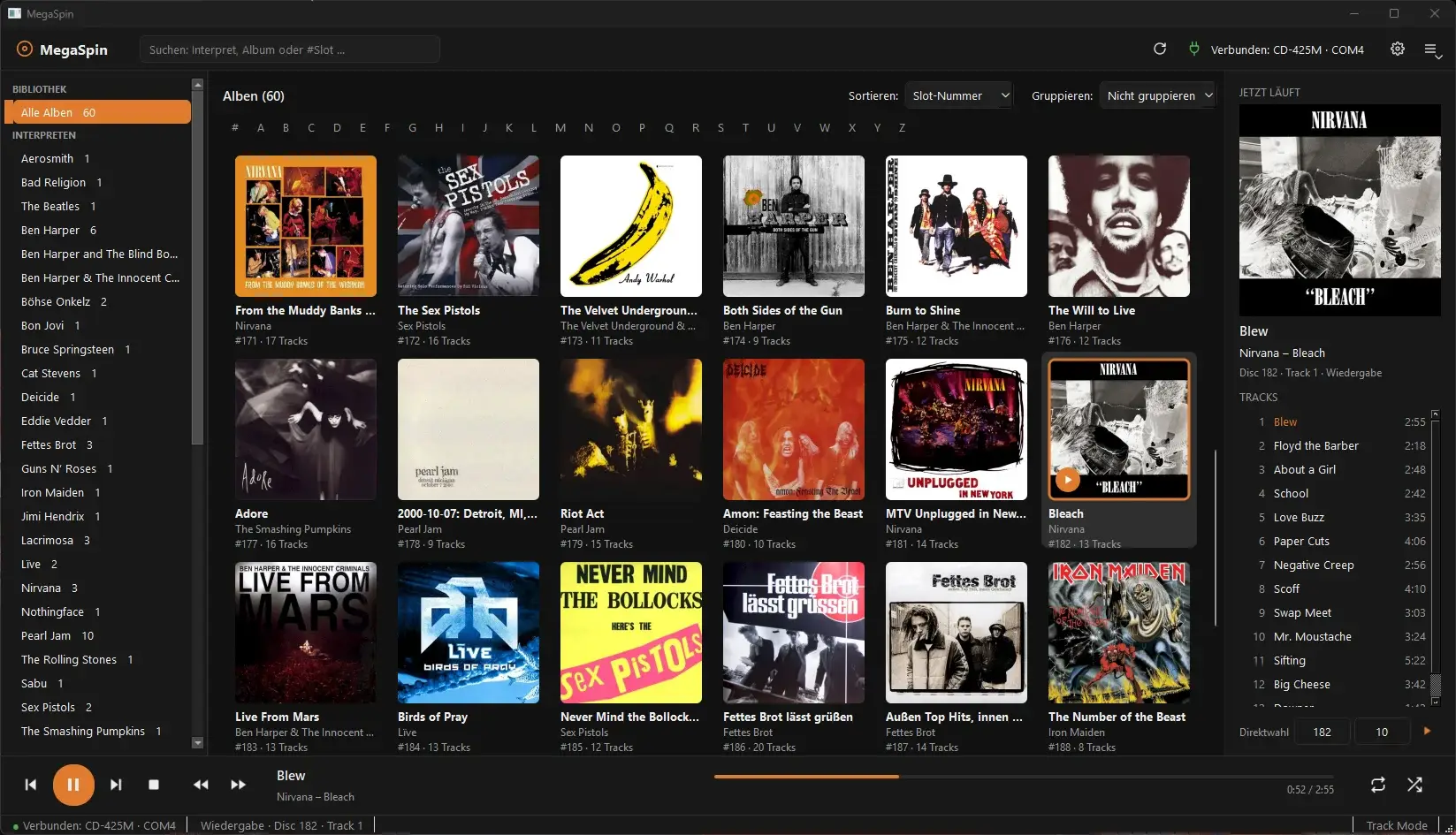
Somewhere in my living room is a CD changer that holds 200 discs. It was built in the late 1990s, it still works, and for most of its life it was controlled by a PC program that only ran on Windows and only looked at one disc at a time. The program relied on CDDB, an online database for disc titles that was shut down years ago. Since then, the titles of most discs have lived nowhere except on the changer’s own small memory.
I wanted to browse the collection the way you browse a music library: covers, artists, playlists. So I built a replacement. It is called MegaSpin, the first beta runs on Windows, and it is open source under the MIT license.
Listening to the line
The changer has a 9-pin serial port for a PC. It talks RS-232 at 9600 baud, 8 data bits, 2 stop bits. What it says on that line is not published anywhere I could find, so the work started with listening.
A serial monitor sat between the PC and the changer and recorded every byte in both directions. Then I pressed buttons: in the PC software, on the remote and on the front panel. Every action left a trace on the line. Putting the traces of similar actions side by side showed which bytes stay the same, which change, and which change in step with what happened on the device.
Sequences: who speaks when
Once the traces were sorted, a structure appeared. The protocol is a classic half-duplex design. Either side asks for the line with an enquiry byte, the other side acknowledges, a frame follows with a length and a checksum, and the session ends with an end-of-transmission byte. Each frame is acknowledged.
Writing every exchange down as a sequence, like a sequence diagram with two lifelines, made the protocol readable. Each request has a fixed order of messages and a limited set of possible answers. And the changer does not only answer: it also starts conversations on its own, for example with a status message whenever the door opens or closes. A program that only sends requests and waits for replies misses half of what is going on.
Timing and flow
The order of the messages is only half of the protocol. The other half is the flow over time: when the changer answers, what it reports while it is busy, and when it is safe to ask again.
The door is a good example. The changer reports every opening and closing of the door, and after the door closes it needs time to detect which discs are in the magazine. An early idea was to poll the changer every minute to find out what had changed. The flow analysis showed that this was unnecessary. MegaSpin now waits until the door has closed and disc detection has finished, then reads the disc list once. Reads of the changer’s memory are kept to a minimum on purpose.
Hypotheses, tested on the device
Every assumption about the protocol became a small test: send a request, record the answer, compare it with the expectation. The changer answered every test, which made it the final judge. A rule only went into the documentation after the device had confirmed it.
A digital twin before the hardware
Testing against a machine that can change its own memory is a bad way to learn. So before MegaSpin touched the real changer, it talked to a simulator that reproduced what I had measured: the handshake, the status messages, the timing, the disc detection and the memory layout. Only after the simulator and the real device agreed did the app run against the hardware. Every feature that writes to the changer was tested that way first.
Firmware quirks are part of the job
The sequences also show where the firmware behaves in unexpected ways. A CD-TEXT disc without a disc title makes the changer answer a title request with an endless stream of empty frames. Read naively, the program waits forever. MegaSpin now gives up on such a reply after a few empty frames, stops acknowledging, waits for the changer’s end-of-transmission, and reads the track titles one by one. That is a workaround, not a fix, and it is documented as such.
Where AI helped, and where it did not
I did this with an AI coding assistant. It was useful for working through long recordings of serial traffic, for writing the many small tests, for keeping the protocol documentation consistent, and for porting the interface into a second language. It was not a substitute for the measurements. When the assistant guessed, the hardware corrected it, and every protocol claim in the documentation carries a note about whether it was measured on the device or taken from someone else’s notes.
Status
MegaSpin is a beta. It works every day for my own collection, but it has not been tested on many machines. The Windows installer, screenshots and the list of supported changers are on the MegaSpin page. The protocol notes and the source code are on GitHub at github.com/pasce/megaspin. If you own one of these changers, I would be glad to hear what works and what does not.
Analysing an old serial protocol is a small, quiet kind of engineering. You do not get to see the design decisions anyone made. You only get the behaviour on the line, and you have to be honest about the difference.
Written with AI assistance and reviewed by the author.